Celebrate Earth Day at LNRP's Lakeshore Love Brewery Benefit at 3Sheeps
Lakeshore Natural Resource Partnership Named 3 Sheeps Brewery Nonprofit of the Month; Hosts April 19 “Lakeshore Love Brewery Benefit
Lakeshore Natural Resource Partnership (LNRP) has been selected as 3 Sheeps Brewery’s Nonprofit of the Month for April 2026. Throughout the month, $1 from every pint of 3 Sheeps’ Wisconsinitis sold at the Sheboygan taproom will be donated to LNRP to support local conservation efforts.
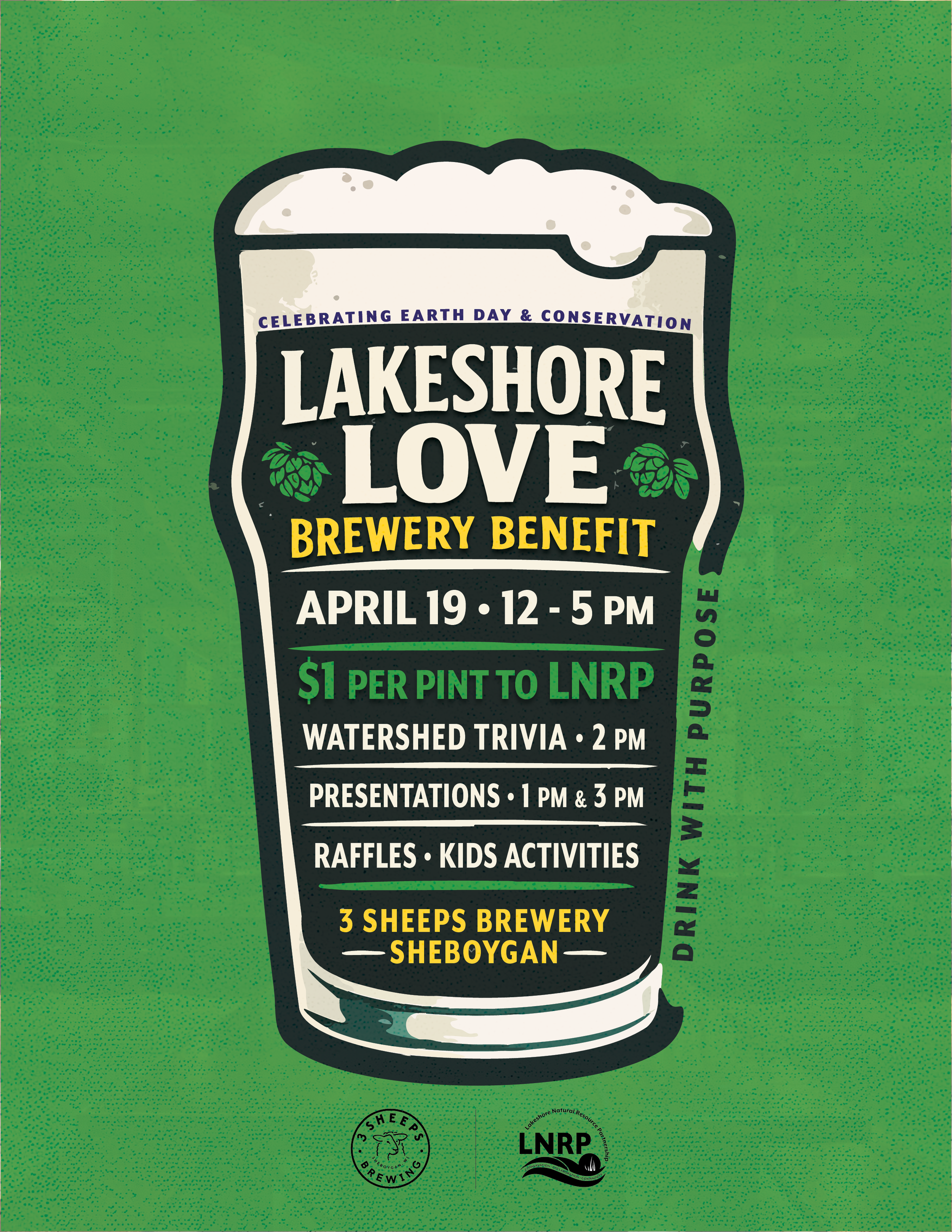
The collaboration will culminate in the Lakeshore Love Brewery Benefit on Sunday, April 19, 2026, from 12:00–5:00 p.m. at the 3 Sheeps Brewery taproom in Sheboygan (taproom hours 11:00 a.m.–6:00 p.m.). During the event, LNRP will receive $1 from every pint sold that day, giving attendees a simple and meaningful way to support clean water initiatives while enjoying a local craft beverage.
“Being named Nonprofit of the Month by 3 Sheeps Brewery is an exciting opportunity to connect with the community in a new way,” said Amy Lentz, Executive Director of LNRP. “Every pint purchased helps protect our lakes, rivers, and watersheds. It is a powerful reminder that local partnerships can create real environmental impact.”
Event Highlights
The Lakeshore Love Brewery Benefit will feature interactive and educational programming throughout the afternoon, including:
12:00 p.m. — LNRP Hangout & Community Networking
1:00 p.m. — Educational Presentation (15–20 minutes)
Rick Hein & Becky Abler, Professors, UW-Green Bay (Manitowoc Campus) - From Classroom to Creek: Student Scientists Driving Water Quality Research2:00 p.m. — Watershed Trivia (45 minutes)
3:00 p.m. — Educational Presentation (15–20 minutes)
Rachel Smith, PHD Student, School of Freshwater Sciences – Quagga Mussels in Nearshore Lake Michigan: Insights from Long-Term Monitoring
4:00 p.m. — Raffle Drawing (winners need not be present)
Ongoing — Kids activities and raffle ticket sales throughout the event
Watershed trivia will offer participants the chance to test their knowledge of local water systems, while educational presentations will highlight current research and conservation efforts impacting the region.
Families are encouraged to attend, with kid-friendly activities available throughout the afternoon.

A Month-Long Impact

As 3 Sheeps Brewery’s April Nonprofit of the Month, LNRP benefits from a month-long give-back initiative. For every Wisconsinitis sold at the taproom during April, $1 will be donated directly to LNRP.
“Drink a Wisconsinitis, protect our waterways,” said Lentz. “It is an easy and enjoyable way for the community to make a difference.”
Funds raised will support LNRP’s mission to protect and improve the health of lakes, rivers, streams, and watersheds across the Lakeshore region through science-based restoration, education, and community partnerships.
Educational PResentations
From Classroom to Creek: Student Scientists Driving Water Quality Research (1PM)
The Stream Team at the University of Wisconsin-Green Bay (Manitowoc Campus) has collaborated with Lakeshore Natural Resource Partnership in research assessing the water quality of Lake Michigan tributary streams since 2009. Our focus is on mentoring undergraduate students as early-career scientists while engaging them in real-world work that impacts the local community. Our work is aimed at determining the impact of restoration and land management improvements on water quality, as well as the impact of land use and environmental conditions on our streams. Student-led research informs the community of water quality issues and opportunities as well as provides the foundation for data-driven land management decisions. This presentation will share how this community-based research program impacts the students as well as sharing some of their work.
Quagga Mussels in Nearshore Lake Michigan: Insights from Long-Term Monitoring (3PM)
Zebra and quagga mussels (dreissenids) are among the most infamous invasive species worldwide. Introduced to the Midwest in the 1980s and 1990s, they now inhabit waterbodies ranging from small local ponds to the deepest regions of Lake Michigan. Dreissenid mussels occupy diverse and complex habitats, and so their effects on water quality are wide-ranging. This presentation will discuss the broad water quality implications of dreissenid mussels and highlight key unanswered questions about their biology. It will then examine long-term monitoring data from nearshore Lake Michigan and highlight emerging management approaches being explored.